Example 1
Polynomial: power, constant multiple and sum rules
Differentiate term by term (sum rule), keeping each constant coefficient in front.
Multiply out the coefficients.
Answer
Type a function to see its derivative and the rule used at every stage, from the first derivative up to the tenth. Use it to check homework, study for a test, or see where a long product or chain rule went wrong.
Try an example
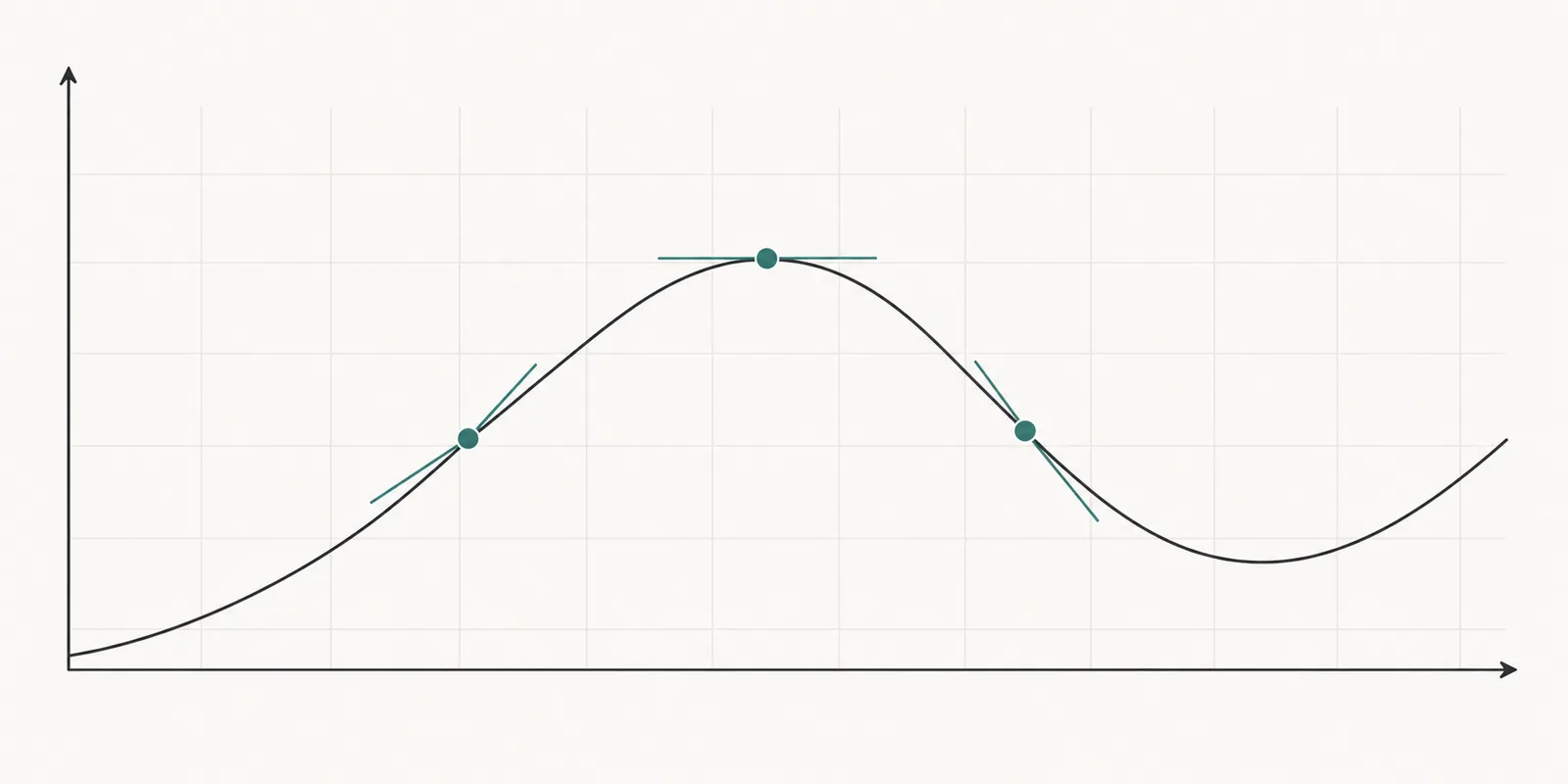
The derivative of a function measures its instantaneous rate of change. Geometrically, f′(a) is the slope of the tangent line to the graph of y = f(x) at x = a. In physics, the derivative of position is velocity; in economics, the derivative of cost is marginal cost.
Formally, the derivative is defined as a limit of difference quotients. In practice nobody evaluates that limit each time: a small set of rules, applied in the right order, differentiates every function built from powers, exponentials, logarithms and trigonometric functions.
Every step in a solution names one of these rules. Learning to spot which one applies is most of the work.
Works for any real exponent, including roots such as √x = x^(1/2) and reciprocals such as 1/x² = x^(−2).
Differentiate term by term and keep constant factors in front.
Used when two non-constant factors are multiplied.
The order in the numerator matters: derivative of the top first.
Differentiate the outer function, keep the inside, then multiply by the derivative of the inside.
For u(x)^v(x), where both base and exponent vary, the calculator uses logarithmic differentiation.
Inverse trig functions are covered too, e.g. (arctan x)′ = 1/(1 + x²).
Your input is parsed into an expression tree, which the live preview shows so you can confirm it was read the way you meant. The calculator then walks the tree from the outside in. At each node it applies exactly one rule (sum, product, quotient, power, chain, or a table derivative) and records that step with the intermediate result.
Each intermediate result is simplified exactly, using fractions rather than decimals: like terms are combined, powers of the same base merged, and values such as sin(π/6) = 1/2 evaluated. When expanding a product gives a shorter answer, the expanded form is shown; otherwise the factored form is kept.
For higher-order derivatives the process repeats on the simplified previous result, and every order gets its own list of steps. Finally the answer is compared against a numerical finite-difference estimate at several sample points as an independent check.
For the full details, including how answers are verified, see how the solver works.
Work through these by hand first, then enter them above to compare each step.
Example 1
Differentiate term by term (sum rule), keeping each constant coefficient in front.
Multiply out the coefficients.
Answer
Example 2
Let f = x² and g = eˣ, so f′ = 2x and g′ = eˣ.
Factor out eˣ (optional).
Answer
Example 3
With f = x² + 1 and g = x − 1, we have f′ = 2x and g′ = 1.
Expand the numerator: 2x² − 2x − x² − 1 = x² − 2x − 1.
Answer
Example 4
The outer function is sin(u) with inner function u = 3x² + 1, so u′ = 6x.
Answer
Example 5
First derivative (product rule):
Differentiate again (product rule on the first term, power rule on the second):
Answer
d/dx sin(3x) is 3cos(3x), not cos(3x). Whenever the argument is anything other than plain x, the chain rule adds a factor.
(fg)′ is not f′·g′. For x²·sin x that shortcut gives 2x·cos x, which is wrong; the product rule gives 2x sin x + x² cos x.
f′g − fg′ and fg′ − f′g differ by a sign. Remember “low d-high minus high d-low”.
1/2x is read as (1/2)·x, and sin x^2 as sin(x²). Use parentheses, such as 1/(2x) or (sin x)^2, and check the preview before solving.
Like most computer algebra systems, the calculator reads log(x) as the natural log ln(x). For base 10, type log10(x) or log(x, 10).
Choose the order from the Order menu (up to the 10th derivative). The solution shows the steps for each order separately, so you can follow how the first derivative feeds into the second.
Yes, in a limited way. Pick the variable you are differentiating with respect to; every other letter is treated as a constant. For example, with variable x, d/dx (a x² y) = 2axy. It does not compute mixed partials in one step.
Derivatives can be written in many equivalent ways. The calculator chooses a compact form, which may be expanded where your book factors (or the reverse). Check equivalence by expanding both, or by plugging in a value of x.
No. The calculator differentiates explicit functions y = f(x). For implicit differentiation, differentiate both sides by hand, using the calculator to check individual pieces.
It looks at the outermost operation of the expression. A sum gets the sum rule, a product the product rule, a quotient the quotient rule, and a function of something other than plain x gets the chain rule. It then works inward.
Pick one of the worked examples, solve it on paper, then enter it in the calculator and compare your steps with each rule shown. Spotting where your work differs is the fastest way to improve.
Back to the calculator