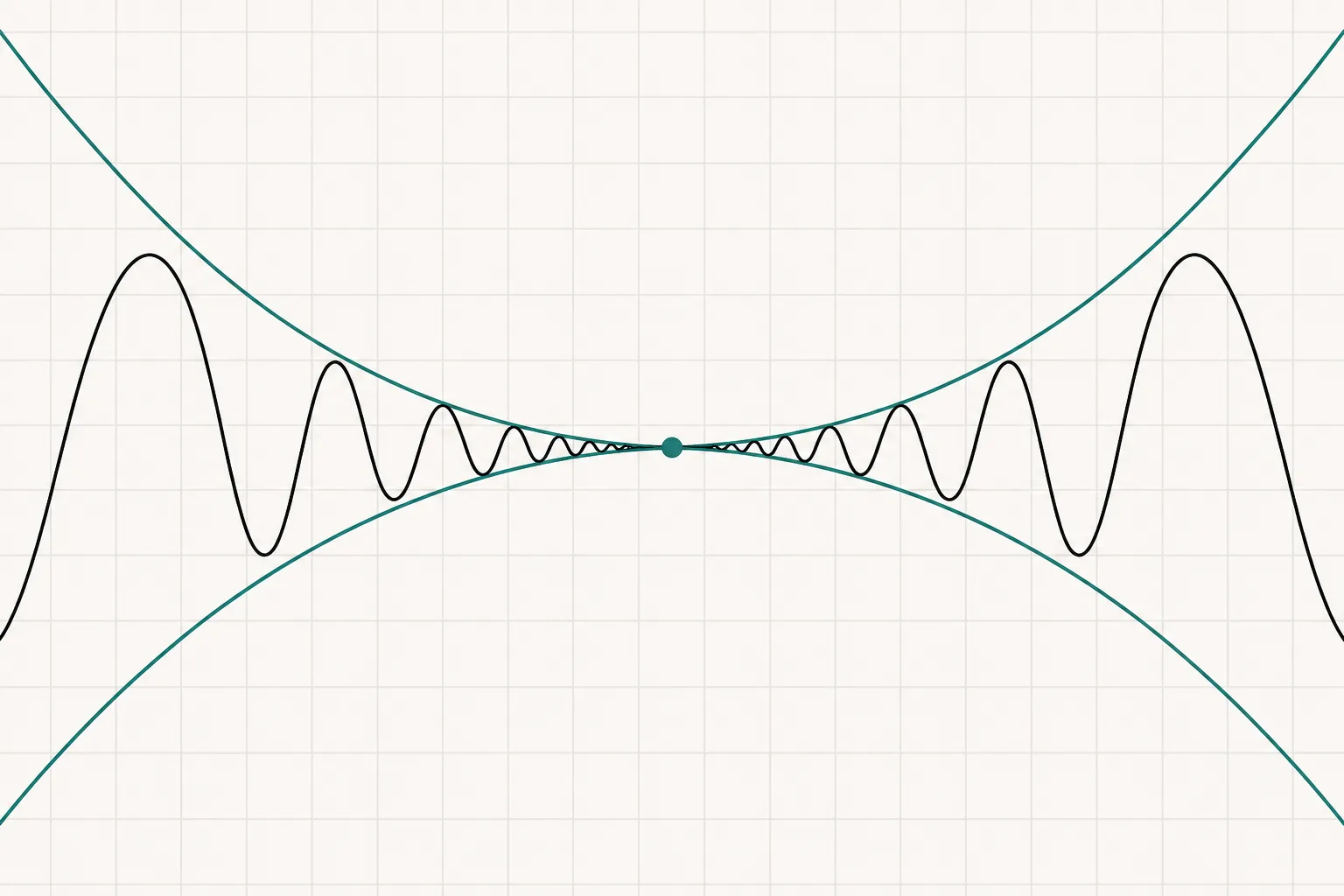
What the squeeze theorem says
Suppose three functions g, f and h satisfy g(x) ≤ f(x) ≤ h(x) for every x near a (except possibly at a itself). If g and h have the same limit L at a, then f is forced to have that limit too:
The idea is simple: f is sandwiched between g and h. As x approaches a, the lower function g and the upper function h both close in on L, so f, which is always between them, has nowhere else to go. That is why the result is also called the sandwich theorem or the pinching theorem.
The theorem works the same way for one-sided limits (x → a⁺ or x → a⁻) and for limits at infinity (x → ∞ or x → −∞). In each case the inequality only needs to hold on the side, or far enough out, that the limit looks at.
Note: The two outer limits must be equal. If they differ, the squeeze theorem gives no information about the middle function.
When should you use the squeeze theorem?
Reach for the squeeze theorem when the usual methods fail and the expression contains a factor that is bounded but has no limit. Typical signs:
- A sine or cosine of something that blows up, such as sin(1/x) as x → 0 or cos(x) as x → ∞. These oscillate between −1 and 1 forever, so they have no limit.
- That bounded factor is multiplied by something that goes to 0, such as x², √x or e^(−x).
- Substitution gives an undefined expression, and L'Hôpital's rule does not apply or makes things worse.
The product rule for limits, lim(f·g) = lim f · lim g, cannot be used here, because one of the two limits does not exist. The squeeze theorem gets around that by never needing the limit of the oscillating factor, only its bounds.
If the limit is a 0/0 or ∞/∞ fraction of smooth functions with no oscillating factor, L'Hôpital's rule is usually faster. Learn when it applies in L'Hôpital's Rule Explained With Examples.
How to use the squeeze theorem, step by step
- Step 1: Find the bounded part. Write down an inequality you already know, most often −1 ≤ sin(anything) ≤ 1 or −1 ≤ cos(anything) ≤ 1.
- Step 2: Build up to f(x). Multiply, divide or add to every part of the inequality until the middle is exactly f(x). Multiplying by a positive quantity keeps the inequality signs; multiplying by a negative one flips them.
- Step 3: Find the limits of the two outer functions. They should be easy limits, found by substitution.
- Step 4: Check that the two outer limits are equal. If they are, f has that same limit. If they differ, the bounds are too loose and the theorem says nothing.
Step 2 is where care is needed. In x² sin(1/x), the factor x² is never negative, so multiplying −1 ≤ sin(1/x) ≤ 1 by x² is safe. In x sin(1/x), x can be negative, so use absolute values instead (see the next section).
Tip: Most squeeze problems start from −1 ≤ sin(…) ≤ 1 or −1 ≤ cos(…) ≤ 1. Find the bounded factor first, then build the rest of the function around it.
The absolute value shortcut
When the limit you expect is 0, there is a quicker form of the theorem that avoids sign problems:
This follows from the squeeze theorem, because −|f(x)| ≤ f(x) ≤ |f(x)| and both outer functions go to 0. In practice it means you can bound |f(x)| instead of f(x). For example, |x sin(1/x)| = |x|·|sin(1/x)| ≤ |x|, and |x| → 0, so x sin(1/x) → 0 as x → 0, whether x is positive or negative.
The most famous squeeze: sin(x)/x as x → 0
The limit of sin(x)/x as x → 0 is the reason the derivative of sin x is cos x, and it is usually proved with the squeeze theorem. Comparing the areas of two triangles and a circular sector in the unit circle gives, for small x ≠ 0:
As x → 0, cos x → 1 and the constant 1 stays at 1. Both bounds have the same limit, so the squeeze theorem gives the result:
Note that x must be in radians. In degrees, the same limit equals π/180.
This limit, used inside the limit definition of the derivative, is what gives d/dx[sin x] = cos x. To see how the definition turns into the everyday differentiation rules, read How to Find the Derivative of a Function.
Note: This limit only equals 1 when x is measured in radians, which is why calculus always uses radians.
Common mistakes to avoid
- Using bounds with different limits. From −x² − 1 ≤ f(x) ≤ x² + 1 near 0, the limits are −1 and 1, which tells you nothing about f.
- Forgetting to flip the inequalities when multiplying by a negative number. Multiplying −1 ≤ sin(1/x) ≤ 1 by x is only safe for x > 0; use |x| or the absolute value shortcut instead.
- Writing lim sin(1/x) = 0 or treating lim x sin(1/x) as (lim x)(lim sin(1/x)). The limit of sin(1/x) as x → 0 does not exist, so the product rule for limits cannot be used.
- Checking the inequality only at the point. It must hold for all x near a, not just at x = a, where f may not even be defined.
- Squeezing when it isn't needed. If substitution, factoring or L'Hôpital's rule works, use it; the squeeze theorem is for the cases they cannot handle.